
You might have heard that ADHD and some other neurodevelopmental differences involve difficulties with executive functioning, but what exactly is that?
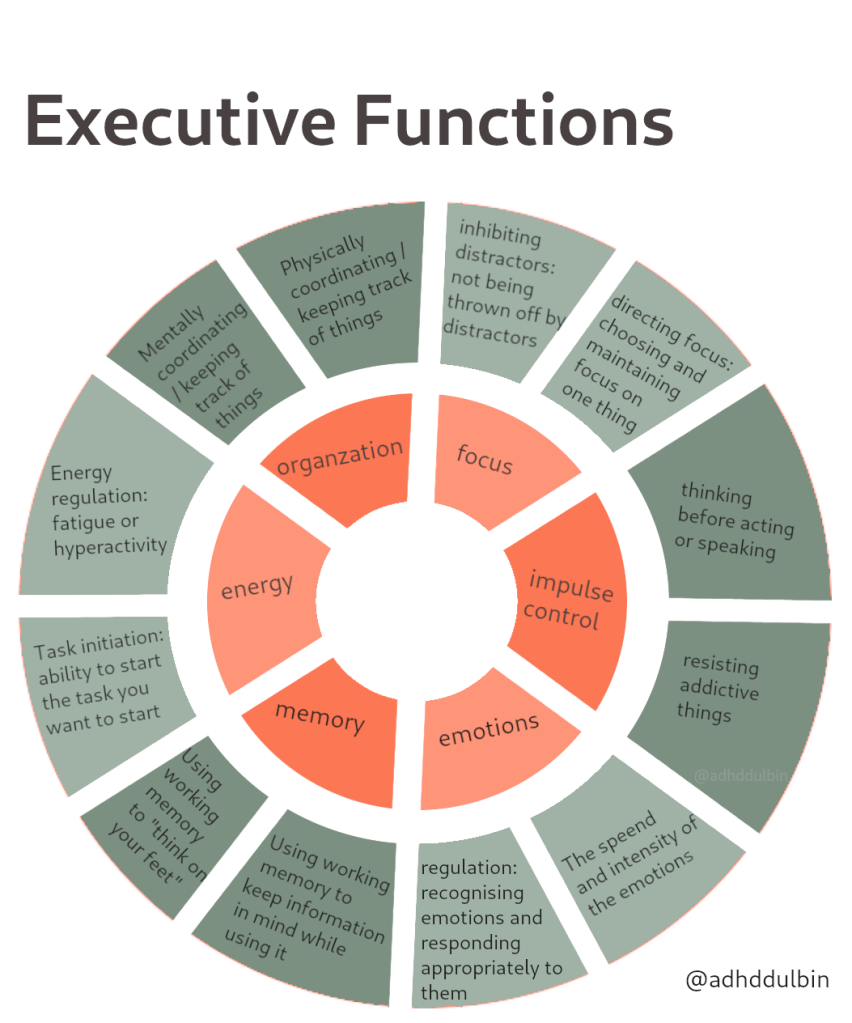
This is a term that refers to a certain set of abilities that seem to be associated with each other. Thomas E. Brown puts them under the headings of memory, emotion, impulsivity, focus and attention, organization, and energy. Someone with executive dysfunction might struggle in some or all of these areas.
Why does executive dysfunction happen?
This is a tricky question, it probably has something to do with the prefrontal cortex (the part of your brain behind your forehead) as well as having the right quantity of neurotransmitters in the right part of the brain at the right time for you to do the thing you are trying to do. And what accounts for these brain differences? They are neurodevelopmental differences present from birth. About 80% of the difference can be accounted for by genetics, and there are likely environmental factors influencing how the brain develops that start working on gametes before the person is even conceived.
What does executive dysfunction feel like?
Imagine, one day Bernice wakes up. She has a lot to do today, she starts with going to the bathroom to brush her teeth. While she is there, she notices the mirror needs cleaning, so she goes downstairs to get what she needs to clean it. While she’s in the kitchen, she realizes she is hungry and decides to make breakfast, but first she checks the emails on her phone. While on her phone she notices she has some social media notifications and she loses an hour on social media. Now she’s annoyed at herself, she promised herself she was going to stay offline and get things done today. She has her breakfast and goes to brush her teeth, but then she sees her toothbrush isn’t where it should be. Where could it be? She starts looking for her toothbrush, frustrated: she can’t go out without brushing her teeth. While she is looking for her toothbrush she gets distracted by multiple other tasks that need doing, and it is hours before she finally finds her toothbrush: in the cupboard with the window cleaner. At this point she is so tired and frustrated with herself that she starts to cry. Why does this always happen?
We can see Bernice struggled to focus on what she was doing , to ignore distractions (tasks were interrupted), to keep track of what she was doing and how she was feeling (toothbrush got carried to cleaning cupboard, didn’t notice she was hungry until in the kitchen), resist impulses (went on social media), emotionally regulate (she got very upset). Everybody might have a day like this occasionally, but with executive dysfunction it’s a regular occurrence, and that’s on the days when the person has the energy and drive to attempt tasks at all.
Can executive dysfunction be cured?
For people with ADHD, there are several medications that have proven very helpful for executive dysfunction. There are both stimulant and non-stimulant options. A psychiatrist can diagnose ADHD and prescribe medications. There’s an old saying “pills don’t teach skills”, and some people find that after accessing medication they still benefit from ADHD therapy focused on executive functioning, to help them put systems in place.
Without access to medication it is still possible to put systems in place to limit the impact of executive dysfunction.
 Rebecca Bourke
Leave a comment