
When we talk about attachment we are talking about love: what the experience of love is like for the person.
Avoidant attachment was first identified in toddlers who would behave sullenly and look distant when their caregiver returned after leaving them alone for a short time. On the surface they looked unaffected but ECG and EEG scans show their hearts and minds were racing in stress.
All the toddlers in the study were stressed, but the avoidantly attached toddlers weren’t able to ask for comfort from their caregivers and their caregivers weren’t able to comfort them upon their return.
In an adult, avoidant attachment can often mean that the closer someone gets to another in a relationship, the more distant they feel and act. If they don’t know about their attachment style, they might interpret this as a lack of compatibility with their partner or “the dopamine wearing off”.
Even if they do know their attachment style, they are still left with the conundrum of figuring out if this relationship genuinely isn’t working out, or if it’s their attachment style talking.

How do you get a secure attachment style?
By working in a secure relationship with a securely attached person. This could be a close friendship, a romantic relationship, or a professional relationship with a therapist.
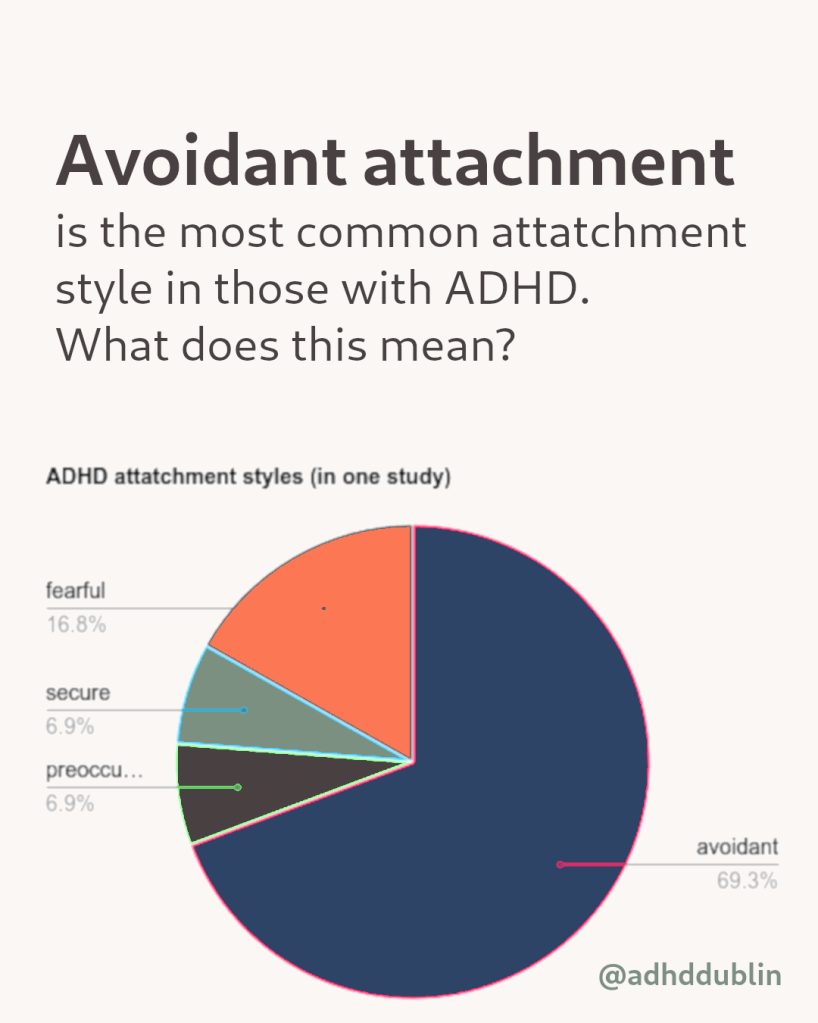
Different studies have different percentages for ADHD attachment styles but they all seem to show:
Avoidant attachment is the most common style among people with ADHD, 7-10% have a secure attachment style (Koemans et al., 2012; Storebø et al., 2013).
Approximately 70% of neuroptyicals are securely attatched. (Keller, 2018; van IJzendoorn & Kroonenberg, 1988).)
Recent Posts
Author: Rebecca Bourke, BSc (Hons), MIACP
Accredited Counsellor & Psychotherapist | ADHD Specialist
[Important Disclaimer: The information contained in this article is for educational purposes only and is not intended as a substitute for professional medical advice, diagnosis, or treatment. Always seek the advice of your qualified mental health professional with any questions you may have regarding a medical condition.]
 Rebecca Bourke
Leave a comment